

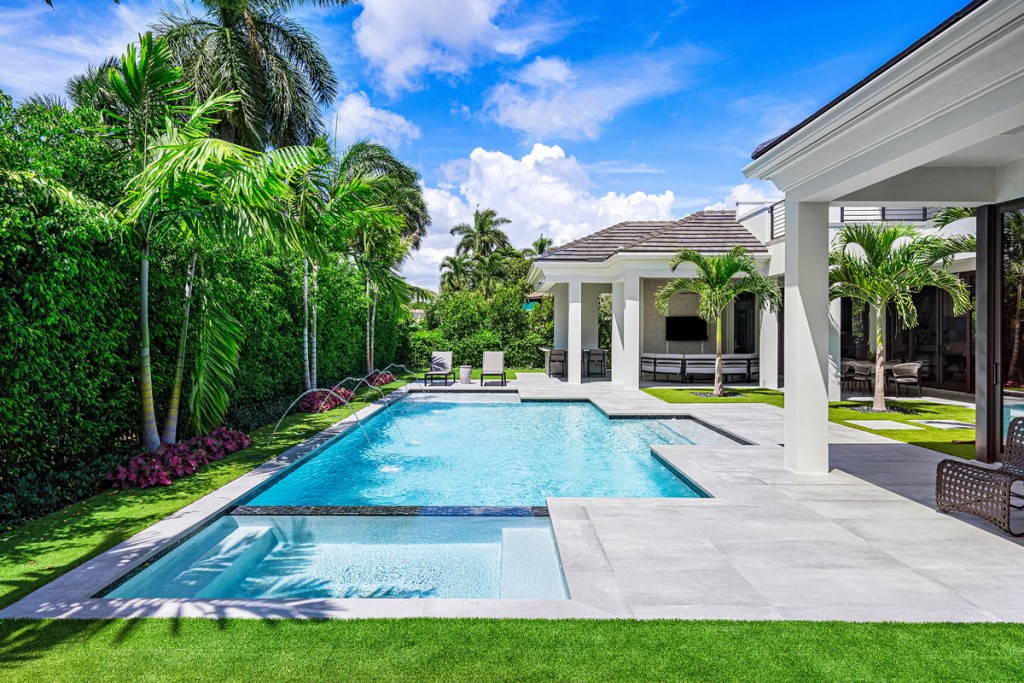
Transform your backyard into an ultra-luxurious playground for you and your guests to enjoy
Tired of spending your time indoors doing the same old thing? Not sure how to elevate your outdoor space? Lucky for you, we have a few tips on how to improve your backyard, taking it from a neglected area to an ultra-luxurious hangout to entertain guests.
In most of the country, the patio is a seasonal luxury—useful for a handful of months, then covered and forgotten. In Boca Raton, it is a core living space. With roughly 231 to 240 sunny days a year and overnight lows that rarely fall below the upper 50s, South Florida delivers two and a half to three times the comfortable outdoor entertaining days of a Northern metro like New York or Chicago. The prime season runs backward from what Northerners expect: November through May is nearly ideal, with daytime highs in the 75°F to 85°F range and low humidity, while covered loggias, screening, and pool access keep summer evenings viable straight through the rainy months.
That climate advantage changes what an outdoor space should be. In a Royal Palm Yacht & Country Club home, the backyard is not an amenity to add on—it is an extension of the residence, engineered to the same standard as the interior. The five upgrades below reflect how that standard actually gets built in a waterfront, salt-air environment.
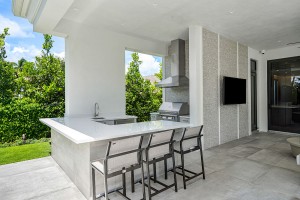
OUTDOOR KITCHEN
An outdoor kitchen at this level is an architectural extension of the main home, not a prefabricated grill island. Custom high-end builds generally run $35,000 to $75,000, while estate-level cooking suites—dual grills, a power burner, a wood-fired pizza oven, integrated refrigeration, and a covered pavilion—reach $75,000 to $150,000 and beyond.
What separates a luxury build from a standard one in this climate is material specification. Salt air, humidity, and UV exposure will rust, warp, or fade ordinary outdoor materials within two to three years. The builds that last specify:
- 316 marine-grade stainless steel rather than standard 304, which is prone to “tea-staining” and pitting near saltwater. The added molybdenum in 316 resists salt corrosion.
- HDPE or closed-cell polymer cabinetry (such as NatureKast), which mimics teak or walnut but is fully waterproof and impervious to salt air.
- Engineered porcelain slabs for countertops—non-porous, UV-stable, and heat-resistant—or sealed leathered granite. Quartz yellows under direct UV, and unsealed marble or concrete stains readily, so both are avoided outdoors.
Buyers at this level expect the space to function as smoothly as their indoor kitchen: a built-in grill from Lynx, Hestan, or Wolf; a beverage station with a UL outdoor-rated refrigerator and a clear-ice maker; and a split-level layout that keeps a 42-inch bar counter for guests separate from the 36-inch prep zone. Overhead pergolas with flush-mounted infrared heaters, fans, and misting lines extend comfort across the full year.
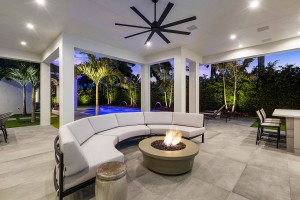
FIRE FEATURE
A fire feature in Boca Raton is built for ambiance far more than warmth—and the fuel choice is dictated by more than preference. Within communities like RPYCC, gas is the dominant standard for practical and regulatory reasons.
Wood-burning fires create smoke, flying embers, and ash that clings to wet patio surfaces and screen enclosures, and they are prohibited under covered lanais because of the fire hazard. Florida code requires open wood fires to maintain significant setbacks—often 25 to 50 feet—from structures and property lines, and they remain subject to drought-season burn bans. Most premier East Boca Raton HOAs either ban wood-burning pits outright or heavily restrict them over smoke complaints and ember risk to neighboring homes and yachts.
Plumbed gas features are a different story. They ignite instantly, produce zero smoke or ash, and are exempt from burn bans. In RPYCC, custom linear fire tables, pool-coping bowls, and built-in gas pits are routinely approved through the Architectural Review Committee, provided lines are buried and equipment is screened from street and waterway views. Note that any exterior fire feature, hardscaping, or gas line requires ARC submission and approval before installation.
Because temperatures sit between 75°F and 90°F most of the year, these features are designed around visual drama—reflective fire glass, flames running along an infinity edge, water-and-fire integration—with burners that adjust down low for a summer glow. On the crisp 60°F evenings of December through February, the same feature provides localized radiant heat, often paired with overhead infrared heaters on covered dining areas.
POOL
In South Florida, a pool is not an optional upgrade—it is standard infrastructure, and the financial logic reflects that. Nationally, a pool adds roughly 5% to 8% to home value and often recovers less than half its construction cost. In Boca Raton, a well-designed pool adds an estimated 10% to 15% or more in appraisable value, with cost recovery reaching 60% to 80%.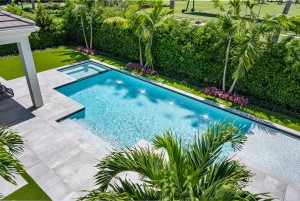
The more important dynamic is what happens without one. At the $1.5M-plus price point, buyers expect a pool, and homes lacking one tend to sit longer or sell at a discount that can exceed the cost of building new—largely because buyers want to avoid a 12-to-18-month permitting and construction delay. On a $2M home, a luxury pool can represent an appraisal lift of $150,000 to $250,000 or more.
At this level, buyers expect the pool to integrate with the architecture and the view:
- Infinity edges on lakefront, intracoastal, or golf course lots, where water spills over a weir to visually blend into the background.
- Sun shelves in six to nine inches of water, sized for in-water loungers and umbrella sleeves.
- 360° perimeter-overflow spas finished in glass tile, spilling evenly over all four sides into a hidden slot.
- Swim-up bars and submerged seating paired with a dry-side bar or sunken kitchen.
- Smart automation (Pentair, Hayward) for heaters, RGB lighting, and water features controlled by phone.
On the systems question, saltwater is the dominant choice for luxury custom builds—worth clarifying that a saltwater pool is a chlorine pool; an electrolytic cell simply generates chlorine automatically from dissolved salt. That continuous feed is the advantage in 85°F-plus summers, when sun burns through chlorine quickly and heavy rains trigger algae blooms. The one common exception: homes directly on the ocean or saltwater canals sometimes stay with traditional chlorine to avoid compounding salt corrosion on nearby furniture and appliances.
HOT TUB
A spa pairs naturally with a pool, but the integrated-versus-standalone decision comes down to architectural cohesion versus hydrotherapy performance.
An integrated gunite spa is seamless—matching the pool’s tile, coping, and stone—and heats on demand in roughly 30 to 60 minutes, typically running $15,000 to $35,000 as an addition to a pool build. A standalone acrylic spa offers superior ergonomics, with molded seating and 30 to 80-plus targeted jets, and stays hot around the clock, at $8,000 to $20,000 plus slab and electrical. For a cohesive luxury build, the integrated spa almost always wins on aesthetics; the standalone wins where dedicated hydrotherapy is the priority.
The wellness case is well supported. Chest-deep immersion reduces effective body weight by 75% to 90%, taking gravitational load off the joints, and warm-water immersion has been shown to raise pain-pressure thresholds and ease chronic musculoskeletal pain. Water at 100°F to 102°F induces vasodilation, while hydrostatic pressure aids venous return and circulation. The combination of heat and massage also shifts the body from a sympathetic to a parasympathetic state, lowering cortisol and supporting sleep.
In current luxury design, the spa is positioned as a wellness node within a larger resort-style ecosystem—often elevated 12 to 18 inches for a 360° spillover effect that reads as a water mirror when idle, placed adjacent to a cold plunge for contrast therapy, or built beside a sunken fire-pit lounge so guests in the water sit at eye level with those on the sofas.
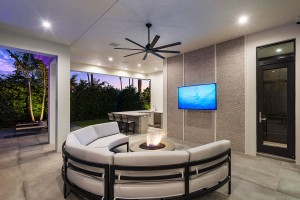
OUTDOOR THEATER & SOUND
An outdoor AV system on an open waterfront lot demands a different engineering approach than an indoor or inland setup. Salt spray, humidity, UV, and the absence of walls to reflect sound will defeat standard equipment—and even standard outdoor gear—quickly.
On the video side, ordinary indoor TVs run 300 to 500 nits and wash out in daylight. Purpose-built outdoor displays (Samsung The Terrace Full Sun, SunBriteTV, Séura) output 1,500 to 4,000 nits, carry an IP55 or IP56 weather rating at minimum, and include internal heating and cooling to survive wide temperature swings without shutting down.
Sound is where waterfront properties get difficult, for two reasons: there are no walls to reflect audio back, and wind and water compete with it. Mounting two large speakers on the house wall and turning them up produces ear-splitting sound near the home and thin, washed-out audio at the water’s edge. The luxury approach distributes six to twelve smaller satellite speakers every 12 to 15 feet along garden and path perimeters, aimed back toward the living zones, creating an even 65 to 75 dB “blanket” at conversation-friendly volume. In-ground subwoofers add bass without visible boxes.
Because open water reflects and carries sound farther than land, those satellites should be angled downward into seating areas to keep audio inside the property line and avoid complaints across the canal. DSP amplifiers tuned to the speakers boost midrange and low-end so music stays full against ocean wind. Materials matter as much here as in the kitchen: 316 stainless or solid-brass housings (Coastal Source, James Loudspeaker), carbon-fiber or polypropylene cones, conformal-coated circuit boards, and tinned copper direct-burial wiring that won’t oxidize in salt air.
Bringing It Together in Royal Palm
Each of these upgrades performs best when designed as part of a single, cohesive outdoor environment rather than a series of add-ons—and when specified for the salt-air, waterfront reality of East Boca Raton. That is precisely the standard found throughout Royal Palm Yacht & Country Club, Boca Raton’s premier waterfront and golf community.
Royal Palm Properties has been the community’s dedicated brokerage since 1985 and remains the only firm focused solely on RPYCC real estate. Broker/owner David W. Roberts, a 40-plus-year resident and active club member, is involved in more than 60% of all transactions within the community and closed over $623M in RPYCC sales in 2024. If you are looking for a home built for year-round outdoor living, browse active RPYCC listings or contact the RPP team to find the right property.