

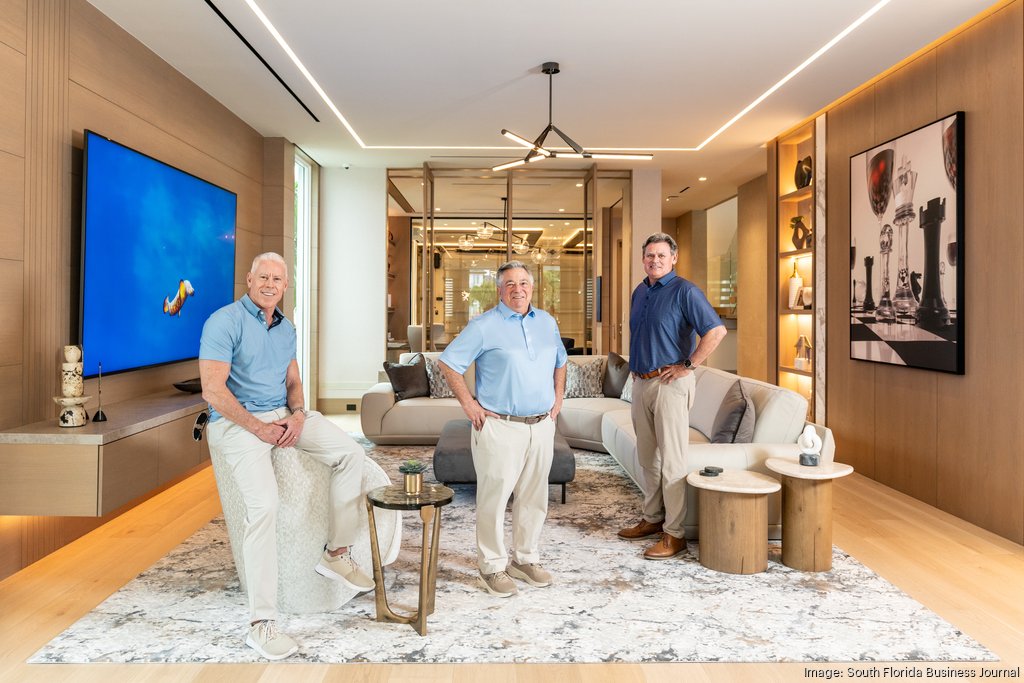
 South Florida’s luxury spec-home market is on a record-breaking run, as wealthy buyers snap up move-in-ready mansions at prices once considered unthinkable.
Building expansive mansions to attract wealthy buyers has long been a lucrative business in South Florida. But the market for homes priced at $10 million and above have soared, with prices reaching new heights in coveted enclaves such as Miami Beach, Coconut Grove, Coral Gables, Boca Raton, Manalapan and Palm Beach. That surge in demand has prompted developers to pay record sums – sometimes more than $20 million – for older homes they plan to demolish and replace with new luxury estates.
The boom in spec mansions business has created opportunities not just for developers, but for real estate investors who fund developers, construction lenders, real estate agents, and companies involved in home design and staging. It’s also led to luxury redevelopment in neighborhoods that previously didn’t have many new homes. However, peak-level land prices create more risk for developers because prime lots are more expensive than ever.
The spec home development market in South Florida is the best in the country when it comes to the world-class architects and designers crafting these homes, said Dina Goldentayer, a Miami-based agent with Douglas Elliman who is among the highest grossing agents in the region. Ninety percent of the spec homes are sold furnished and turnkey.
“The market is being propelled by billionaires not feeling wanted by their states, particularly on the West Coast, and buyers don’t want an older house even from the 1990s,” she said. “The prices for land going up is a reflection of the finished home prices going up.”
Goldentayer said if a spec home that previously sold for $25 million now trades for $40 million, that justifies higher land prices for many of the neighboring lots.
According to MLS data analyzed by the MR Luxury Group at One Sotheby’s International Realty, there have been 18 new single-family homes sold in Miami-Dade County for at least $10 million year-to-date through October for a total of $575.5 million. The number of closings was greater than any year since 2020. The previous record year for dollar volume was 2024, but 2026 has already doubled that.
In Palm Beach County, there were 21 $10 million-plus sales of new homes year-to-date for $386.7 million – also record volume but slightly below the price total for full-year 2021. It was on pace to break that record.
Broward County typically records two to three $10 million-plus spec home sales a year.
Buyers from California and New York have driven up the prices for spec homes in South Florida and they are demanding higher quality builds more than ever, said Marko Gojanovic, an agent with MR Luxury Group in Miami. Top spec homes were selling for $4,000 per square foot in 2020, but now many of the best builds command $6,000 per square foot, he said. This means homebuilders need to go above and beyond in terms of the quality of construction and finishes, including furnishings, to land a buyer at that cost level.
“There’s a big opportunity and a lot of people got into the business of homebuilding,” he said. “But only a handful of builders who are very successful can attract a buyer at $6,000 per square foot… Plus, there’s a finite amount of prime waterfront land in Miami-Dade County.”
In Palm Beach County, many wealthy buyers now prefer move-in ready homes, said Jim McCann, a broker with Premier Estate Properties. A decade ago a buyer might hire their own design team and take their time with a new build or restoration of a historic home. But today’s buyers have even greater wealth and are willing to pay millions more for a turnkey property, he added.
“More than ever, high-end buyers want instant gratification and they are willing to pay for it, which is one reason the developers are getting paid,” McCann said. “If you are a billionaire and come to South Florida and want a home on the ocean, you don’t want to play around with finding vacant land and going through the development process. If you find a home your family likes, it’s easier to just write the check.”
Record Deals
Many sales price records set this year in particular neighborhoods were thanks to spec homes. That includes a $75 million sale at the Royal Palm Yacht & Country Club in Boca Raton, a $69.5 million sale in Golden Beach, a $48.5 million sale on the Venetian Islands, and a $24 million sale in the San Souci neighborhood of North Miami. The broker for that Boca Raton deal, David Roberts of Royal Palm Properties, said a great location with a large lot is imperative to selling a spec home for top dollar. That’s why the best waterfront lots in Royal Palm trade in the high $20 millions, he added.
The other factor in setting a record price is premium construction, Roberts said. That means all concrete on the first and second floors, full electronics packages, and a fully furnished house. Builders should not try to save costs, he said. “The premium product is the fastest for us to sell,” Roberts said. “Never apologize for the price – the price gets set aside when there’s quality.” As demand for luxury homes in Royal Palm has climbed, the supply of lots has diminished. Roberts said Royal Palm started with 747 home sites but there are now 650 homes because lots have been consolidated over the years to build larger homes. That has driven up land prices.
That consolidation has continued. Scott Dingle of SRD Builders, which completed that $75 million mansion in Royal Palm, said they’ve assembled several lots along the Intracoastal Waterway to create a mega mansion that will sell for $80 million to $100 million – another record. Over 35 years of development, he’s built 175 homes in Royal Palm, and he’s even torn down homes he built in the 1990s to build new ones.
“They are only 20 years old but styles change and features change,” Dingle said. “The land is worth more than the house and it allows us to keep going and generating new homes.”
SRD Builders doesn’t leave rooms empty, so buyers can enjoy them right away. Wellness features are a big trend in these modern mansions, Dingle said. That can include saunas, cold plunges, steam rooms, massage areas, gyms and yoga studios, video walls, virtual game rooms with golf simulators, and lavish water features at the entrance.
“The quality levels of the finishes continues to go up and the amount of detail you can put into them makes it fun,” Dingle said. “And that’s driving the cost up. You spend more and you have to charge more. But you’ve got some über wealthy people down here and this is what they want.”
Luxury homebuilder Todd Michael Glaser has set records before – including a $150 million sale in Palm Beach in 2024 – and he aims to do it again. Glaser said he has the 2.21-acre property at 911 N. Ocean Blvd. under contract for $160 million. He plans to demolish the home, split the lot in two, and build two mansions that he hopes to sell for $200 million each.
Glaser favors the mega deals because there’s almost no competition at that price point. The top echelon of wealthy people in the U.S. has seen their wealth grow exponentially in recent years, so that has raised the bar for top-tier mansions, he said.
“There is no sales velocity for these houses until a guy like me comes in who finds the $200 million buyer,” Glaser said. “It would be $260 million to $300 million if it was one big house instead of two. That market doesn’t exist now, but it will.”
Higher prices equals greater risks
Those record home sales have led to record land prices, which has created more risk for spec homebuilders, who must justify the land value in their business plans.
When soccer star David Beckham and singer Victoria Beckham purchased a spec mansion on North Bay Road in Miami Beach for $72.3 million in 2024, that set the spec home market on fire and caused many other sellers to raise their prices, said Barry Brodsky, head of Miami-based Bronson Luxury Homes. Soon, spec mansions were breaking records on the Venetian Islands and Sunset Islands. The challenge for developers is to make the numbers work with higher land prices, he said.
For example, Brodsky said if he buys a Miami Beach lot for $20 million, he’ll probably spend $15 million to build a house given the high costs of construction, building finishes comparable to a high-end hotel, and the shortage of well-trained craftspeople who can deliver such a product. Add in the carrying costs of taxes, insurance and maintenance over four years, that’s at least a $42 million cost. Say the home sells for $60 million, that’s an annual rate of return of just under 11%.
“It’s an enormous project to build a home of that size and quality, and not many homes sell for over $60 million every year,” Brodsky said. “Now, a local wealthy person might scoff at a home at that price, but a wealthy person from a high tax state who’s afraid of a billionaire tax is operating on a different currency.”
Terry Paterson, CEO of Lighthouse Point-based luxury homebuilder Paterson Project Management, said his development pipeline is smaller than usual because it’s hard to find ideal sites at the right price. He builds homes priced between $10 million and $40 million, so he needs a unique property that justifies the amount of money he’ll spend on construction. Building a house for under $10 million isn’t worth it, as it’s the bigger deals that net more profit, he said.
“It’s a risk. Developers are typically Type A risk personalities,” Paterson said. “As long as your land and location can handle the valuation you are seeking, then the more money you put into the home, the more money you will get back. But don’t go too crazy or you could lose.”
Pascal Nicolai, CEO of Miami-based luxury homebuilder Sabal Development, said higher land prices have made it more difficult to justify spec home projects. For instance, four years ago he could buy land in Palm Beach for $10 million, but now the same land costs $30 million. After buying the land, developers need to spend tens of millions of dollars on construction, carrying costs and sales commissions.
“If I’m paying $30 million for land, I need to sell a $100 million house,” Nicolai said. “The numbers are crazy. Who can sustain this? It’s not the spec home developer. It’s the people who are buying for themselves.”
Nicolai said he avoids overpriced land and focuses on neighborhoods where land is less expensive, such as waterfront property in North Miami Beach, Fort Lauderdale and Boca Raton.
“No matter what you pay for the land, if it’s at the right price for the market, it will sell,” he said. You need to buy the right lot and build the right way.”
Luxury homes in new neighborhoods
Many spec homebuilders have found success outside of the top-tier neighborhoods by building in popular locations with less expensive land.
Brodsky said Miami’s Bay Point, Miami Shores and North Miami Beach have become ideal markets for spec homes on the water. Even non-waterfront lots in Pinecrest can be great for spec homes, but it’s a different buyer dynamic as owners there are more concerned about being near private schools.
Premier Estate Properties’ McCann said there’s a spec housing boom in West Palm Beach south of Southern Boulevard, where he’s seen homebuilders from New York build multiple spec homes.
“Homes in West Palm Beach off water can sell for over $15 million on a 13,000-square-foot lot. I would have never predicted that a few years ago,” McCann said. “Instead of buying one big property in Palm Beach, developers are buying a half dozen sites in West Palm Beach.”
Related businesses cash in
From architects to lenders to home furnishers, companies that work with luxury homebuilders are cashing in.
Kobi Karp, the CEO of Miami-based Kobi Karp Architecture, said he’s working with more luxury spec developers now because they need him to design homes that mirror luxury hotels to meet the standards of discerning buyers. He’s crafting homes with full wellness centers, including pedicure/manicure rooms, hot and cold plunges, and gyms. They often have staff kitchens and living suites with separate entrances from the primary residents. In neighborhoods with higher elevation like Coconut Grove, he’s designing underground parking garages so they can maximize living space on the first floor.
“Buyers don’t want to go through the time it takes to design, permit and build a house, which can take three to four years,” Karp said. “So, they look at what is on the market now. They are willing to over pay to get their time back.”
While lenders rarely like to speculate on commercial construction loans, some of them are eager to fund spec home development for experienced sponsors who offer personal guarantees. Zack Simkins, managing partner of Miami-based private lender Vaster, said spec home loans are his most popular request now. He’s done many spec home takeout loans – replacing the original financing for developers who went over budget or need more time. Still, he’s cautious about providing too much leverage to developers.
“It gives me some reason for concern because not all leverage is created equal,” Simkins said. “If you are over 80% loan-to-construction cost, what is going to happen once those properties are built and interest rates rise and push out the buyer pool? If you don’t have the influx from New York and California, the market will eat you up.”
J.C. de Ona, the Florida division president for Centennial Bank, said it makes construction loans for spec homes at 60% to 65% of construction costs, or roughly half the value of the finished home. There were times the leverage was as high as 70%, but it lowered it to be more cautious, he added.
“Every single loan we’ve done for a spec home, when it sells it was higher than what we analyzed and appraised it at, so the market continues to be really healthy,” de Ona said.
Due to its many spec homes, South Florida is a bustling market for home staging companies like Vesta Home. CEO Julian Buckner said he started the company eight years ago in Los Angeles and expanded to South Florida during the Covid-19 pandemic because he saw home projects moved faster there. It launched a turnkey division with interior designers in Miami so buyers can move into a home that’s fully furnished.
Homes with staging spend less time on the market and that saves developers on carrying costs, he added. Plus, Vesta Home eliminates the need for developers to purchase furniture and hold onto it if the buyer declines to keep it. For example, Vesta Home could furnish a property with $1 million worth of furniture for a cost of $200,000. If the buyer chooses not to purchase the furnishings, Vesta Home takes it back and reuses them in another home.
“To spend half a million dollars on furniture and then hope you sell it with the home is tough for a developer,” Buckner said. “So developers should not get into the furniture business.”
–– Brian Bandell
Read the full article:
https://www.bizjournals.com/southflorida/news/2026/11/19/spec-home-developers-capitalize-record-prices.html