

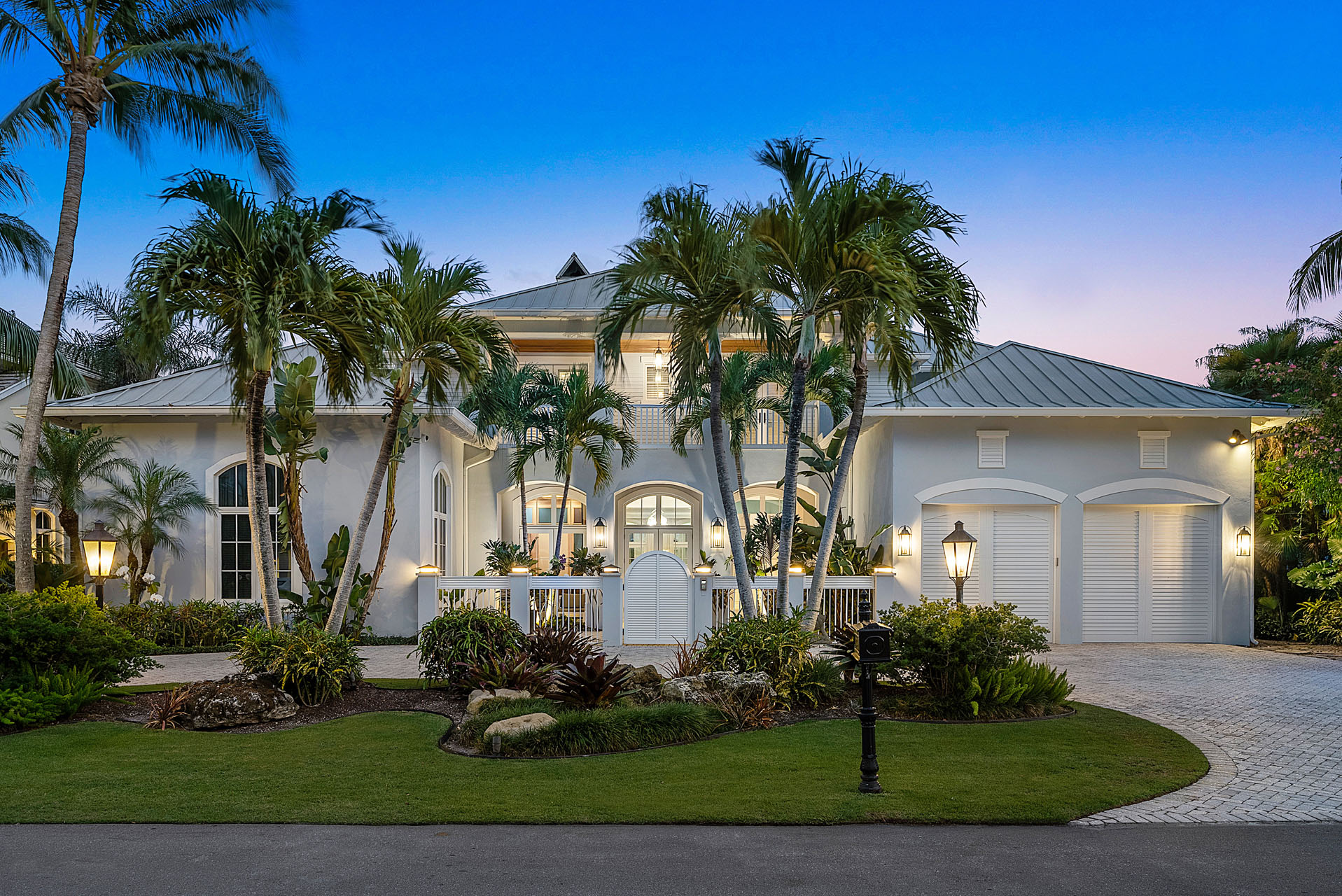
Most advice about reducing stress in a real estate transaction is written for a market that does not resemble this one. Set goals, hire an agent, trust the process — none of it is wrong, and none of it prepares a buyer for a Royal Palm Yacht & Country Club purchase in which club membership is neither automatic nor guaranteed, the seawall behind the property may carry a six-figure liability, and the vessel the buyer intends to keep at the dock may not physically clear the bridge between that dock and the Atlantic.
Stress in a South Florida luxury transaction comes from specifics. It comes from a fifteen-day inspection clock that starts on the effective date whether or not the marine engineer has availability. It comes from discovering that a Citizens Property Insurance policy caps dwelling coverage at $700,000 in Palm Beach County, which excludes essentially every home in Royal Palm. It comes from a membership application that takes sixty to ninety days to move through sponsorship, interview, posting, and a board vote — a timeline that does not pause for a closing date.
This guide covers what actually creates friction in a Boca Raton transaction and how to sequence the work so those items surface early, when they are still negotiable, rather than late, when they are merely expensive.
The Market You Are Transacting In
Boca Raton’s broad single-family market carries a median sale price hovering near the $1 million threshold, in the range of $990,000 to $1,013,000 depending on the month and neighborhood cluster, with overall residential values up more than 20% year over year. That figure describes the city. It does not describe Royal Palm.
Within Royal Palm Yacht & Country Club, the trailing twelve-month median sale price stands at $10,000,000, an 11.1% increase over the prior twelve-month period. Average price per square foot sits near $1,483, with average sold prices running between $10.5 million and $13.5 million depending on the mix of new construction and existing inventory. Active listings currently span from roughly $4 million for teardown and land-value lots to more than $38 million for ultra-custom turnkey waterfront estates. Sellers have been accepting an average of approximately 90% of original asking price.
The wider Palm Beach County luxury market has been running at unusual strength. Q2 2026 recorded 156 closings totaling $984.2 million, a 58% increase in transaction volume over Q2 2025. Sales at or above $20 million more than doubled year over year, rising from six transactions to thirteen, capped by a $55.1 million single-family estate sale.
Three characteristics of this market shape how a transaction should be approached.
Cash dominates. Roughly 55% to 65% of Boca Raton transactions above $1 million close all-cash. Above $5 million, that share rises to 75% to 85% or higher. Elevated interest rates have pushed ultra-high-net-worth buyers toward cash liquidity specifically to eliminate financing contingencies and compress closing timelines. A financed offer in this segment competes against offers with fewer moving parts, and the gap has to be closed elsewhere — on price, on terms, or on certainty.
Pricing discipline determines speed. Across the broad $1 million-plus segment, days on market run roughly 75 to 90 days. Above $5 million, the average extends to between 106 and 168 days. That average conceals a wide split. Properties priced accurately to the market move in 30 to 60 days. Properties priced to test aspirational ceilings absorb the long tail and drag the average upward. The distinction is not about the property. It is about the list price.
Individual sales are not comparable in the ordinary sense. Recent Royal Palm closings illustrate how wide the band is. 2500 E. Maya Palm Drive closed at $75,000,000 in May 2026 — an all-time record for Boca Raton — for a new SRD Signature estate on nearly an acre with 292 feet of Intracoastal frontage, at $4,101 per square foot. In the same period, 293 Sabal Palm Terrace, an existing golf-view home, closed at $6,350,000, or $1,065 per square foot. Both are Royal Palm sales. Neither tells you much about the other. Valuation here requires segmenting by water access, lot position, and construction vintage before any comparison is meaningful.
Step One: Define Criteria, Not Goals
Generic goal-setting produces generic results. In this market, the criteria that matter are physical and specific, and getting them wrong is expensive to correct.
For Buyers
Water access is the primary variable. Deepwater waterfront lots in Royal Palm typically run 0.35 to 0.75-plus acres and trade between roughly $15 million and $35 million, at $2,400 to $3,500-plus per square foot. Golf course adjacent lots typically run 0.33 to 0.50-plus acres and trade between roughly $8 million and $18 million, at $1,600 to $2,200 per square foot. The delta is not a matter of taste. It reflects a fundamentally different asset.
Vessel compatibility must be verified before, not after. This is the single most common source of late-stage disappointment in Royal Palm purchases, and it involves three separate constraints.
Dock capacity. Private deepwater docks behind residential lots can accommodate vessels of roughly 100 to 120-plus feet, depending on total waterfront linear footage. City of Boca Raton code requires vessels to be moored parallel to the dock and within property setback lines, with typical 10-foot setbacks from each side property line. The practical formula: usable dockable length equals waterfront frontage minus approximately 20 feet. A lot with 100 feet of frontage does not berth a 100-foot yacht.
Club marina alternative. The Royal Palm Marina operates 60 floating slips accommodating yachts up to 120 to 130 feet, with dual power, water, and pump-out service. Slip assignments are managed under Social or Golf membership and remain subject to availability and vessel registration approval. Marina access is a membership privilege, not a purchase right.
Ocean access height and draft. The Camino Real bridge crossing the Intracoastal Waterway at Mile Marker 1048.2 is a bascule drawbridge with 9 feet of closed vertical clearance at mean high water and 125 feet of horizontal clearance, opening on signal via VHF Channel 9 or horn. Height is not a limiting factor there. The limiting factor is the Boca Raton Inlet bridge at A1A, which is fixed at 23 feet of vertical clearance. Flybridge yachts, sportfish vessels with towers, and sailboats exceeding that height cannot exit through Boca Inlet at all. They must run approximately five miles south to Hillsboro Inlet, which has a 21-foot drawbridge, or continue to Port Everglades.
Draft imposes a parallel limit. The federal channel target depth at Boca Inlet is 7 to 10 feet, but strong littoral currents cause rapid shoaling and shifting sandbars. Safe maximum draft for regular inlet transit runs approximately 5.5 to 6.5 feet at high tide. Vessels drawing more than 7 feet generally stage out of Port Everglades or Lake Worth Inlet.
A buyer whose vessel exceeds 23 feet in air draft or 7 feet in water draft is purchasing a home with dockage, not a home with convenient ocean access. That is a valid decision. It is not a valid surprise.
Membership intent. Whether the household intends to pursue Golf Equity or Social membership affects the total cost of ownership by a material margin and should be settled before offers are written, for reasons covered in the next section.
For Sellers
The relevant questions are narrower than generic advice suggests, and each has a factual answer rather than an aspirational one.
- What is the current condition and remaining service life of the seawall, and does documentation exist?
- Is the dock permitted, and are as-built drawings and permit records available?
- Are there any open or unresolved Architectural Review Board items on the property?
- What is the wind mitigation profile of the structure, and when was the last inspection performed?
- What net proceeds are required, after documentary stamp tax, brokerage, and any FIRPTA withholding?
- Does the sale trigger a homestead portability window that constrains the timeline for the next purchase?
Every one of these will be raised by a qualified buyer’s representative. Answering them in advance converts them from negotiating leverage into marketing material.
Step Two: Understand the Membership Layer
Royal Palm Yacht & Country Club operates as a private, invitation-only equity country club. Purchasing a home within the subdivision does not grant club membership. This is the most consequential structural fact about buying in Royal Palm, and it is routinely misunderstood.
Membership Categories
Golf Equity Membership includes full access to the Jack Nicklaus Signature golf course, practice facilities, tennis and pickleball, the fitness center, dining, and marina privileges. Initiation runs approximately $210,000 to $250,000, with annual dues near $30,000.
Social / Full Equity Membership provides access to all non-golf facilities, including the marina, tennis and pickleball courts, the wellness complex, pool, and the club’s fine and casual dining outlets. Initiation runs approximately $250,000, with annual dues between roughly $22,000 and $27,708.
Marina dockage and slip assignment sit under both categories, subject to slip availability and vessel registration approval.
The Application Sequence
- Sponsorship. The candidate must be formally nominated and sponsored by active equity members in good standing, typically two primary sponsors plus supporting letters.
- Vetting and submission. Financial background verification, personal references, and background checks accompany the formal application.
- Committee interview. The applicant and family attend a formal interview with the Membership Committee.
- Posting and board vote. Candidate names are posted to the general membership for a mandatory review period, generally 14 to 30 days, before the Board of Governors votes.
- Timeline. The full process runs 60 to 90 days. Membership caps mean waitlists apply, particularly for Golf Equity.
The practical implication is a sequencing problem. A buyer who signs a contract in February with a 45-day close and begins the membership process at contract will own the home well before the board votes. Sponsorship relationships, in particular, are not something that can be assembled on a closing timeline. Buyers who intend to join should begin conversations about sponsorship before they are under contract, not after.
The Royal Palm Improvement Association and Architectural Review Board
Royal Palm is governed by the Royal Palm Improvement Association (RPIA) rather than a conventional HOA structure, and the RPIA’s Architectural Review Board (ARB) enforces community design standards with real teeth.
Written ARB approval is required before commencing any new residential construction, exterior structural modification, house paint color change, driveway or patio paver replacement, roof material change, or major landscaping overhaul. Plans, surveys, site drawings, and material samples must be submitted at least 72 hours ahead of a scheduled meeting, and the ARB convenes twice monthly. Standards extend to community-approved mailbox models and driveway entrance bollards.
For buyers planning renovation or a teardown-and-rebuild — a common strategy given how much of the inventory trades at land value — the ARB calendar belongs in the project schedule from day one. For sellers, any open ARB item is a closing-table problem, because it will appear on the estoppel certificate.
Estoppel Certificates
Florida Statute 720.30851 governs estoppel certificate fees, and the caps are firm:
| Service | Statutory Cap |
|---|---|
| Standard delivery, 10-business-day turnaround | $299 |
| Expedited, 3-business-day turnaround | +$119 ($418 total) |
| Delinquent account surcharge | +$179 |
| Absolute single-parcel cap | $597 |
Certificates are valid for 30 days when delivered electronically or by hand, 35 days when mailed. If the association or management company fails to deliver within the statutory 10-business-day window, it forfeits the right to charge any preparation fee at all.
Order the estoppel early. A certificate that expires before closing has to be reordered, and the validity window is short enough that a two-week delay can force it.
Step Three: Work the Florida Contract Mechanics
The AS IS Inspection Period
The FAR/BAR AS IS contract carries a default inspection period of 15 calendar days from the effective date, unless the parties negotiate otherwise. Within that window the buyer holds an unconditional right to terminate for any reason or no reason, by delivering written notice before expiration, with full return of the earnest money deposit.
Fifteen calendar days is not a long time when the due diligence list includes a general inspection, a marine engineering assessment of the seawall, a dock and lift structural review, a wind mitigation inspection, an elevation certificate, and insurance quotes that depend on the results of several of those. In practice this means vendors should be scheduled before the contract is signed, not after. Buyers who wait until day one to start calling will spend a third of the period on scheduling.
For sellers, the inspection period is the most probable point of failure in a Royal Palm transaction. Pre-listing inspection of the seawall and dock removes the most common source of mid-period renegotiation.
Transfer Taxes
Documentary stamp tax on the deed in Palm Beach County runs $0.70 per $100 of consideration, or any fractional part. A $1,000,000 purchase generates $7,000. A $10,000,000 purchase generates $70,000. Every Florida county uses the $0.70 rate except Miami-Dade.
For financed purchases, two additional recording charges apply. Intangible tax runs 0.002, or two mills, on the principal amount of the new mortgage — $2.00 per $1,000 borrowed. Documentary stamp tax on the promissory note adds $0.35 per $100, or $0.0035. Combined, a borrower pays approximately $5.50 per $1,000 borrowed at recording.
FIRPTA Withholding
The Foreign Investment in Real Property Tax Act requires the buyer to withhold a percentage of gross sales price when acquiring U.S. real estate from a non-resident foreign seller. The obligation falls on the buyer, which makes this a diligence item on both sides of the table.
| Sale Price | Buyer’s Intended Use | Withholding |
|---|---|---|
| Under $300,000 | Buyer’s personal residence | 0% |
| $300,000 – $1,000,000 | Buyer’s personal residence | 10% |
| Over $1,000,000 | Any use | 15% |
| Any price | Investment / non-personal use | 15% |
Given Royal Palm’s price points, the applicable rate on a foreign-seller transaction is effectively always 15% of gross sales price. On a $12 million sale, that is $1.8 million withheld at closing. Sellers in this position should be working with counsel on a withholding certificate application well in advance of listing, not discovering the obligation during title review.
Homestead Exemption and Save Our Homes Portability
Florida’s homestead exemption must be filed by March 1 of the tax year claimed, and the owner must hold legal title and occupy the property as primary residence as of January 1 of that year. Late applications may be accepted through the 25-day post-assessment window in mid-September where extraordinary circumstances are shown to the Property Appraiser.
The Save Our Homes cap limits annual assessment increases on a homesteaded primary residence to 3% or CPI, whichever is lower. Accumulated savings are portable: a homeowner may transfer up to $500,000 in assessment differential to a new Florida primary residence, provided the new homestead is established within three tax years of abandoning the prior one.
For a Florida resident moving within the state — a substantial share of Royal Palm buyers — portability is frequently the largest single tax variable in the transaction, and the three-year window and January 1 occupancy rule together mean the closing calendar has direct tax consequences. A December closing and a January closing can produce materially different outcomes.
Step Four: Coastal and Waterfront Due Diligence
This is the section that does not exist in national homebuying advice, and it is where Boca Raton transactions most often go sideways.
Seawalls
A visual seawall inspection covering structural condition, cap integrity, panel movement, and drainage and weep hole function runs $350 to $750. A comprehensive engineering assessment — commercial diver or ROV video inspection of underwater footings, tieback condition, and soil void detection — runs $1,000 to $2,500 or more.
The reason to spend the higher figure is the replacement cost:
- Concrete panel replacement: $800 – $1,200 per linear foot
- Vinyl or composite sheeting: $700 – $1,000 per linear foot
- Steel or heavy-duty aluminum sheet piling: $1,000 – $1,500+ per linear foot
Replacing the seawall on a typical 100-foot Boca Raton waterfront lot averages $80,000 to $130,000 or more once engineering, city permits, and tieback anchoring are included. On the wide-frontage lots that command premium pricing in Royal Palm, the figure scales accordingly. Soil voids behind a seawall are not visible from above the waterline, which is precisely why the underwater inspection is worth its cost relative to the exposure.
Flood Zone and Elevation
Most waterfront and canal-facing homes in Royal Palm sit in Zone AE — a Special Flood Hazard Area with base flood elevation typically between 7 and 9 feet — or Zone AH. Many interior, non-waterfront lots fall in Zone X, moderate-to-low risk above the 100-year floodplain. Map revisions have consistently pushed coastal zones toward higher base flood elevations.
An Elevation Certificate is mandatory for any federally backed mortgage on a structure in an SFHA. Even under FEMA’s Risk Rating 2.0, which incorporates structural characteristics and elevation data directly, a surveyor-certified Elevation Certificate remains the primary instrument for demonstrating that the lowest finished floor sits above BFE and reducing premiums accordingly. Cost from a licensed Florida surveyor runs $400 to $800.
For cash buyers, who make up the majority of this market, no lender requires the certificate. Obtain it regardless. The insurance implications persist for the life of ownership, and the document is far cheaper to produce during diligence than to chase later.
Insurance
Citizens Property Insurance functions as Florida’s insurer of last resort, and three of its rules matter directly here.
The 20% rule: a property owner becomes ineligible for Citizens if a private market insurer offers comparable coverage priced within 20% of the Citizens rate.
The flood requirement: all Citizens policyholders carrying wind coverage must also carry separate flood insurance regardless of flood zone. For homes with Coverage A of $400,000 or more, flood coverage is mandatory.
The dwelling cap: Citizens caps Coverage A at $700,000 for personal residential policies in Palm Beach County. Homes with rebuild costs above that figure are ineligible outright.
That last rule effectively removes Citizens from consideration for the entire Royal Palm inventory. Buyers here are placing coverage in the private market or excess and surplus lines, where underwriting is stricter, quotes take longer, and the structural characteristics of the home drive pricing far more than they would elsewhere. Insurance quotes should be requested on day one of the inspection period.
Wind Mitigation
A Form OIR-B1-1802 windstorm mitigation inspection evaluates structural features against hurricane exposure, and the resulting discounts are substantial:
| Feature | Specification | Estimated Discount |
|---|---|---|
| Roof geometry | Hip roof, sloped on all four sides | 15% – 35% |
| Roof-to-wall connection | Double wraps or clips rather than toe-nails | 10% – 25% |
| Roof deck attachment | 8d nails at 6″ spacing on ½” plywood | 5% – 10% |
| Secondary water barrier | Self-adhered modified bitumen underlayment | 5% – 15% |
| Opening protection | Impact-rated windows, doors, and garage doors on 100% of openings | 20% – 45% |
Opening protection carries the largest single discount and the strictest condition: the rating applies only when every opening is protected. A single unprotected window or a non-rated garage door forfeits the entire credit. Buyers evaluating older construction should price full opening replacement as part of acquisition cost. Sellers with a favorable mitigation profile should have a current inspection in hand and disclose it in marketing materials, because it translates directly into the buyer’s carrying cost.
Dock and Boat Lift Permitting
Installing or altering a dock or lift requires approval across multiple jurisdictions:
- City of Boca Raton Building Department — signed and sealed engineering drawings, property boundary survey, and structural load calculations for lifts.
- Setback compliance — docks, lifts, and moored vessels must maintain a 10-foot setback from side property line extensions, protecting neighboring riparian rights.
- Navigational limits — structures and vessels generally may not extend beyond 25% of the waterway width, or past the designated federal or city bulkhead line.
- State and federal approvals — a General Environmental Resource Permit from the Florida Department of Environmental Protection, and U.S. Army Corps of Engineers authorization for work in navigable waters.
- RPIA Architectural Review Board approval — required before city permit submission.
The ordering matters. ARB approval precedes the city application, and the ARB meets twice monthly. A buyer planning to add a lift should build that sequence into the timeline rather than assuming a permit is a formality.
Step Five: Time the Market Deliberately
Seasonality in South Florida is structural rather than statistical noise. The seasonal resident population arrives and departs on a predictable schedule, and transaction velocity follows it.
November through April is the inflow window, as seasonal residents, retirees, and out-of-state buyers arrive. January through April is peak transaction velocity: in-person showings, open houses, and cash offers at the top of the market all concentrate here. July through September is the trough, driven by summer heat, vacation schedules, and hurricane season. Buyers active in July and August are predominantly local families or highly motivated relocations.
| Period | Phase | Characteristics |
|---|---|---|
| January – February | Listing expansion | High new inventory, maximum in-person touring, accelerating cash activity |
| March – April | Contract peak | Highest volume of pending contracts, competitive bidding on prime properties |
| May – June | Closing peak | Peak recorded closings from spring contracts, strong median prices |
| July – August | Off-peak transition | Volume cools, inventory shrinks as unsold listings pause |
| September – October | Annual low | Quietest period, hurricane season and school calendar |
| November – December | Pre-season warmup | Seasonal residents return, buyers move to secure homes before year-end |
For sellers, February is the strongest month to list, with early March close behind. Homes listed in February and closing by May have historically captured an average premium of roughly 7.9% over the Boca Raton baseline. Listings entering the market between December and February also reach contract faster, because they meet active winter buyers with the fewest competing options. A secondary window opens in April and May for family relocation buyers working toward an August school-year start.
For buyers, the same pattern inverts. Late-summer and early-fall inventory faces the thinnest buyer pool of the year, and sellers still carrying a listing in September have generally recalibrated their expectations. Negotiating leverage in this market is seasonal, and it is at its highest precisely when foot traffic is at its lowest.
Step Six: Select Representation on Evidence
The conventional advice on choosing an agent is to ask how long they have worked in the area. In a market this narrow, the relevant question is different: how many transactions inside this specific community has this person actually handled?
Royal Palm is a single community with a limited number of annual transactions, a private club with a sponsorship-based membership process, an improvement association with its own architectural review body, and a waterfront inventory whose value turns on frontage, draft, and bridge clearance. Broad regional experience does not transfer to any of it. Meaningful criteria are countable:
- Transaction history inside Royal Palm specifically, expressed as a share of total community volume rather than as general tenure.
- Verified third-party production rankings, not self-reported figures.
- Access to inventory before it reaches the MLS, which in a community with this few annual sales is frequently the difference between transacting and waiting a year.
- Direct familiarity with the club, including active membership and working knowledge of the sponsorship and approval process.
- Documented list-to-sale performance within the community, measured against the roughly 90% of original asking price the market has been producing.
Everything above can be verified. Ask for the numbers.
Working With Royal Palm Properties
Royal Palm Properties began in 1985 as a specialty boutique agency within the Arvida Corporation and remains the exclusive brokerage for Royal Palm Yacht & Country Club — the only real estate company dedicated solely to selling and leasing within the community.
David W. Roberts, Broker and Owner, is a 40-plus-year Boca Raton resident and an active Royal Palm Yacht & Country Club member. He is involved in more than 60% of all real estate transactions within the community and has consistently sold more RPYCC homes than all other agents and brokerages combined. RealTrends Verified ranked him the #8 real estate agent in the nation for sales volume in 2025. He has closed $600 million or more in Royal Palm Yacht & Country Club real estate year-to-date and more than $6 billion in career sales.
David works with a full-time staff selected for market knowledge and service, and Royal Palm Properties provides in-house mortgage, title, inspection, and attorney coordination — which, in a transaction governed by a 15-day inspection period, a twice-monthly ARB calendar, and a 60-to-90-day membership process, is the difference between a coordinated timeline and a series of avoidable delays.
Browse active RPYCC listings or request a complimentary home valuation to begin.
Royal Palm Properties
741 East Palmetto Park Road, Boca Raton, FL 33432
Open seven days, 8:30 a.m. to 5:00 p.m.
(561) 368-6200 | david@royalpalm.com